
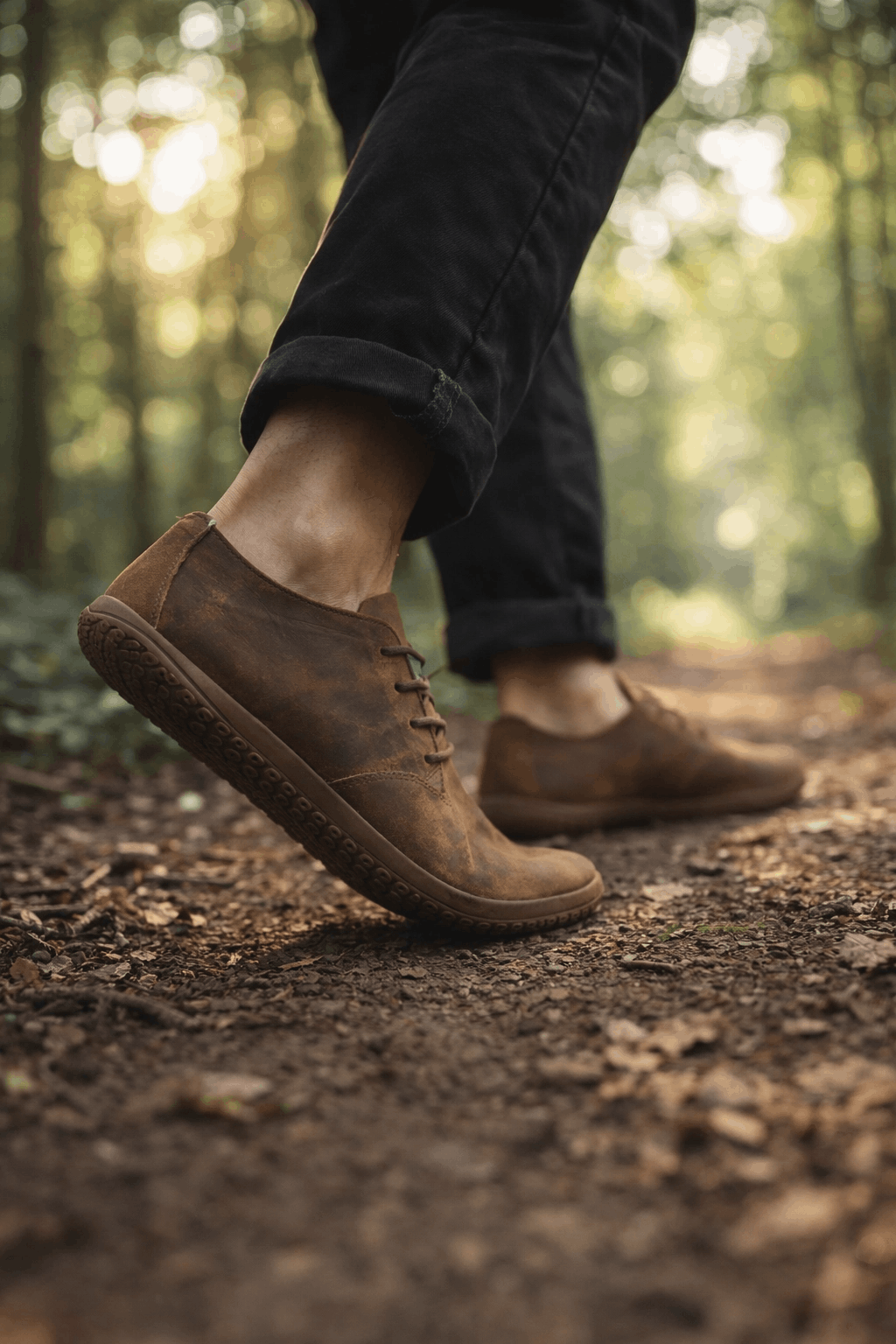
Most men discover barefoot shoes through a problem. A knee that's been grumbling for months. A physio who mentions foot strength with the slightly tired tone of someone who's said it a hundred times. A long walk that left the feet oddly more exhausted than the legs.
What fewer men think about immediately is taking barefoot footwear off-road.
Which is a shame, because that's actually where the argument for it becomes most obvious. Out on a trail, on rough ground, on the kind of terrain that shifts and angles unpredictably under your feet, a conventional hiking shoe's thick, rigid sole stops being a feature and starts being a liability. Your foot can't respond to what's underneath it. The shoe makes the decisions instead, and not always the right ones.
What Men Typically Get Wrong When They Start
The standard mistake is treating the first pair of mens barefoot shoes like a direct replacement for whatever came before. Same distances, same intensity, same terrain. Just different footwear.

It doesn't work like that, and the people who try it usually end up sore in places they didn't expect, mostly the calves and the arch, and conclude that barefoot footwear isn't for them. It is for them. They just skipped the adaptation bit.
The muscles that barefoot shoes rely on have been switched off inside cushioned soles for years. Possibly decades. They need time to come back online before you're asking them to handle a full day in the hills. A few weeks of shorter, easier wear first isn't excessive caution. It's just how the transition actually works.
Barefoot Trail Shoes: Built for Ground That Doesn't Stay Still
Now, let’s see where things get genuinely interesting for anyone who spends time outdoors.
Barefoot trail shoes offer something conventional hiking footwear genuinely can't: actual proprioception on variable terrain. Your foot feels the rock, the root, the shift from packed earth to loose gravel, and adjusts in real time. That feedback loop between foot and ground is what your balance system runs on. Conventional trail boots interrupt it entirely.
The result, once you've adapted, is a kind of sure-footedness that feels counterintuitive given how much less shoe is involved. Your stabilising muscles are actually working rather than being propped up by a rigid structure. Ankles that used to roll occasionally stop rolling, not because they're strapped in but because they're finally strong enough to do the job themselves.
For UK outdoor terrain specifically, sole grip matters enormously. Yorkshire gritstone, Scottish hill paths, the Cotswold clay that turns to ice in November. The BareGrip outsole handles wet and mixed surfaces in a way that keeps outdoor barefoot shoes genuinely usable year-round rather than just in the three weeks of dry summer we occasionally get.
Men's Barefoot Shoes UK: What's Worth Paying Attention to Before You Buy
A few practical things that don't always come up in product listings.
Fit around the heel matters more for trail use than it does on flat ground. If the shoe is moving on descents, that's a problem before you've even thought about the terrain. Lace systems on trail-specific styles exist for a reason. Use them properly.
Stack height, the distance between your foot and the ground, should be genuinely low. Some shoes marketed as minimalist have crept their stack height up to the point where the ground feel has gone. Check the spec rather than trusting the label.
And weight. Outdoor barefoot shoes should feel like not much. If you pick them up and they feel substantial, the sole construction is probably doing something that works against the whole point.